Walkers
A walker or rollator should be selected following assessment of gait, balance, transfers, cognition, hand function, braking ability, environment and intended use. Trial the walker in the person’s usual environments.
Overview
Walkers are wheeled mobility aids that are usually advanced continuously rather than lifted.
Common types include:
- Four-wheeled seat walker or rollator
- Indoor walker
- Tray or trolley walker
- Side-folding walker
- Front-folding walker
- Three-wheeled walker
- Forearm or gutter-arm walker
- Parkinson’s or neurological walker
- Walkers with different wheel diameters
Purpose
- Increase stability during walking
- Reduce lower-limb loading
- Support community or household mobility
- Provide a seat for planned rest breaks
- Support energy conservation
- Carry small personal items
- Improve confidence when the device is correctly selected and used
Who May Benefit
A walker may suit a person who:
- Requires more support than a walking stick
- Can safely use both upper limbs
- Can control a wheeled device
- Can operate the brakes reliably
- Has reduced endurance and may need seated rest
- Has moderate balance impairment
- Walks more safely with continuous support
- Needs indoor or community mobility
- Can maintain an appropriate position within the walker
When a Walker May Not Be Suitable
Consider another option when the person:
- Cannot operate or understand the brakes
- Pushes the walker too far ahead
- Cannot control its speed
- Has severe postural instability
- Requires substantial weight-bearing through the arms
- Cannot use both upper limbs
- Has severe neglect or visual-perceptual impairment
- Cannot turn or manoeuvre the walker safely
- Requires a device that will not roll during loading
- Needs physical assistance beyond what the walker can safely support
Comparison With Other Walking Aids
| Feature | Walker / rollator | Walking stick | Walking frame |
|---|---|---|---|
| Typical support | Moderate, dynamic support | Low, one-sided support | High, broad base of support |
| Upper-limb use | Usually both hands | One hand | Both hands |
| Wheels | Usually 3 or 4 wheels | None | No wheels or 2 front wheels |
| Brakes | Usually hand brakes | None | Usually none |
| Seat | Often available | No | No |
| Pace | Supports a more continuous gait | Minimal interruption to gait | Slower, more deliberate gait |
| Space required | Moderate to high | Low | Moderate |
| Best suited to | Endurance limits, moderate balance impairment, community mobility | Mild balance impairment or unilateral support need | Greater stability needs, reduced balance, early rehabilitation or limited brake management |
| Main limitation | Can move away if braking and control are poor | Provides limited support | Requires lifting or controlled advancement and may be slower |
Why Choose This Aid Instead of the Others
Selection should be based on:
- Required level of support
- Ability to use one or both upper limbs
- Grip strength and hand function
- Ability to understand and operate brakes
- Walking pattern and gait speed
- Falls history
- Endurance and need for a seat
- Indoor and outdoor surfaces
- Doorway and turning space
- Transport and storage needs
- Cognitive, visual and perceptual ability
- Diagnosis-specific needs
- Ability to safely trial the aid
A walking aid should not be selected only because it is familiar, available or inexpensive.
Choose a Walker Rather Than a Walking Stick When
- One-sided support is insufficient
- The person needs bilateral support
- Endurance is limited
- A seat is required
- The person needs a bag or tray
- Balance is moderately impaired
- Community distances are difficult
Choose a Walker Rather Than a Walking Frame When
- The person can manage brakes and a continuously rolling aid
- A smoother gait pattern is desired
- Community mobility is required
- A seat or storage bag is required
- The person does not need to load heavily through a fixed frame
- The environment is suitable for wheels
Choose a Walking Frame Instead When
- Greater stability is required
- Brake use is unsafe or unreliable
- The walker rolls away during transfers or gait
- The person needs a slower step-to pattern
- The person must place substantial weight through the arms
- Early rehabilitation or a temporary high-support aid is required
Types of Walkers
The main types of walker are outlined below.
Four-Wheeled Seat Walker
A four-wheeled seat walker usually includes:
- Four wheels
- Two handles
- Hand brakes
- Parking brakes
- A seat
- A backrest or back strap
- A storage bag or basket
Consider When
- Community walking is a goal
- Seated rest is required
- The person can use the brakes
- The person can turn and control the device
- The person can safely sit and stand from the seat
Limitations
- Requires more space than a stick or frame
- Can accelerate on slopes
- May be difficult over steps and thresholds
- Seat transfers can be unsafe if parking brakes are not applied
- The device is not a wheelchair and should not be used to transport a seated person unless specifically designed for that function
Indoor Walker
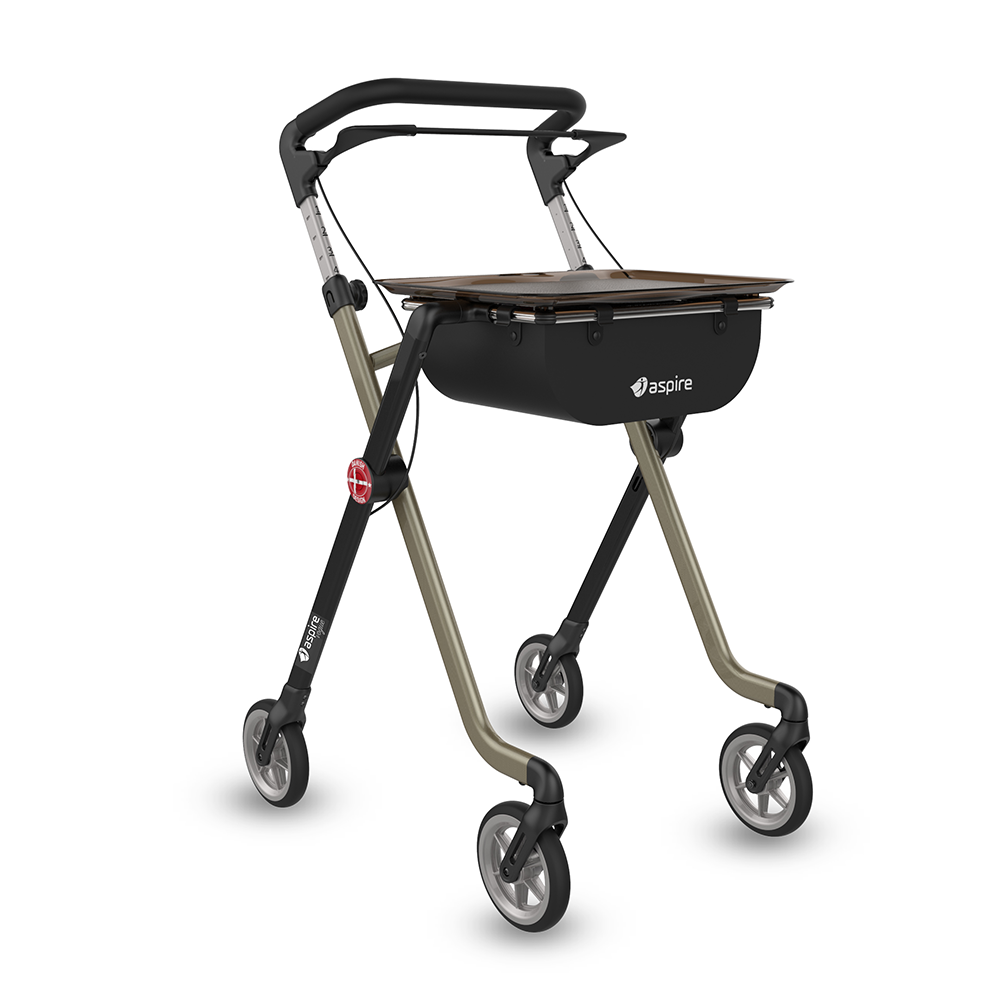
An indoor walker is generally narrower and lighter, with a tray and small bag.
Consider When
- Use is mainly inside the home
- Doorways and furniture create limited space
- The person needs to carry meals or drinks
- A full outdoor seat walker is too wide
- Tight turning is required
Limitations
- Small wheels may be less suitable outdoors
- Usually does not provide a seat
- Trays can affect visibility of the feet and floor
- Hot drinks and uncovered food can spill
- Narrow models may feel less stable for some users
The Aspire Vogue Indoor Walker is an example with a stated handle-height range of 860–970 mm, safe working load of 110 kg, unit weight of 5.1 kg and frame weight of 4.4 kg. Product specifications should be checked at the time of prescription.
Tray or Trolley Walker
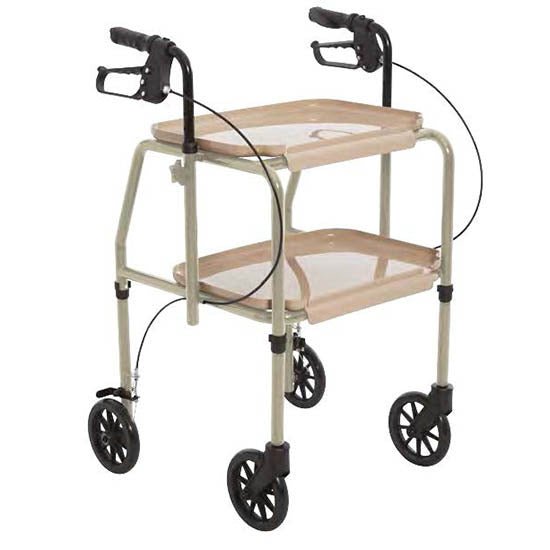
A tray walker supports walking while carrying items.
Consider When
- The person needs to move meals or household items
- Both hands are required on the walking aid
- Carrying items by hand increases falls risk
- The person can safely control the walker while loaded
Check
- Tray height
- Tray stability
- Maximum tray load
- Cup or plate retention
- Ability to see the floor
- Braking access
- Turning space
- Whether the tray can be removed for cleaning
Avoid
- Overloading the tray
- Carrying boiling liquids
- Hanging heavy bags from one side
- Using the tray to pull up from a chair
Side-Folding Walker
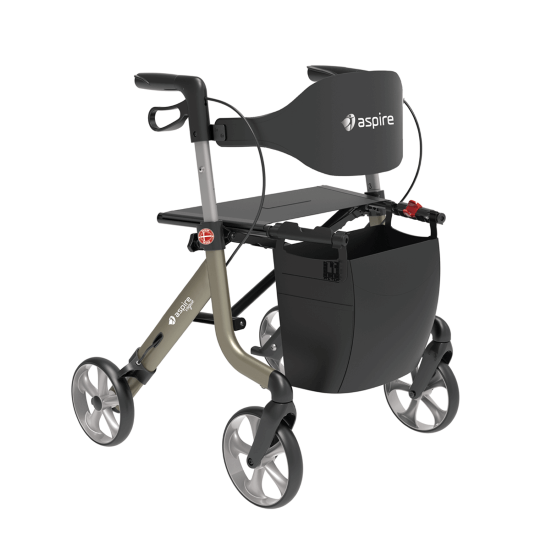
A side-folding walker folds laterally, often bringing the sides together.
Advantages
- May stand more compactly when folded
- Can be easier to store beside furniture
- Some designs remain narrow while moving through spaces
- May suit vehicle storage depending on folded dimensions
Limitations
- Folding method may require hand strength or sequencing
- Folded length may remain substantial
- Hinges and latches require checking
- Some users may accidentally activate a release mechanism
Front-Folding Walker
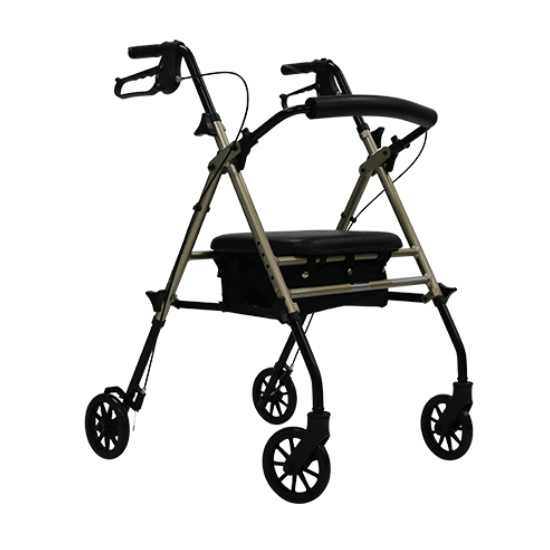
A front-folding walker usually folds by bringing the sides inward toward the front or centre.
Advantages
- Common design
- May fold flat for vehicle transport
- Often familiar to users and carers
- Folding may be simple when the release is accessible
Limitations
- Folded width and thickness vary
- May require two-handed operation
- The front hinge can affect tray or bag design
- Confirm that the frame locks fully open before use
Side-Folding vs Front-Folding
| Consideration | Side-folding | Front-folding |
|---|---|---|
| Storage shape | Often narrow | Often flatter |
| Vehicle loading | Depends on folded length | Often suitable for flat storage |
| Folding action | Lateral compression | Sides move inward |
| Hand function | Check release and force required | Check buttons, straps or central release |
| Standing when folded | Some models may stand | Often needs support |
| Main decision | Best fit for storage space and user operation | Best fit for transport and familiar handling |
Trial the exact model. Folding direction alone does not determine suitability.
Three-Wheeled Walker
A three-wheeled walker has one front wheel and two rear wheels.
Advantages
- Small turning circle
- Narrow profile
- Often lightweight
- Easier to manoeuvre in tight indoor areas
- May fold compactly
Limitations
- Smaller base of support than many four-wheeled walkers
- Usually no proper seat
- May feel less stable during turns
- Can tip if loaded unevenly
- Not ideal for a person who relies heavily on the device
Consider When
- The person needs moderate support
- Space is limited
- The person has good control and judgement
- A seat is not required
- The person does not apply high lateral force
Forearm Walker
A forearm walker supports weight through forearm platforms rather than only through the hands.
Consider When
- Grip is weak or painful
- Wrist or hand loading is limited
- Upright posture is difficult with standard handles
- The person requires greater upper-limb weight-bearing
- Neurological or musculoskeletal conditions affect gait and posture
Check
- Platform height and angle
- Elbow position
- Forearm trough length
- Handgrip reach
- Braking access
- Shoulder elevation
- Trunk position
- Width and turning space
Limitations
- Larger and heavier
- Requires more turning space
- Can be difficult to transport
- Incorrect height can increase shoulder or neck strain
- May require specialised prescription
Parkinson’s or Neurological Walker
A Parkinson’s walker may include:
- A stable U-shaped base
- Reverse or automatic braking
- Adjustable rolling resistance
- Laser visual cueing
- Auditory rhythm cueing
- A design intended to reduce uncontrolled forward movement
The U-Step Neuro is an example of a neurological walker with a U-shaped base, reversed braking and adjustable rolling resistance. Optional laser and sound cueing may support some people with freezing or irregular gait.
Consider When
- Freezing of gait is present
- Festination or uncontrolled acceleration occurs
- Standard rollator brakes are difficult to coordinate
- External visual or auditory cueing has been beneficial during assessment
- A neurologically informed gait assessment supports its use
Clinical Points
- Cueing does not work for every person
- Trial cueing during doorways, turns and gait initiation
- Check whether the cue remains useful during fatigue or distraction
- Confirm the person can understand and activate controls
- Review medication timing and functional variation
- Involve physiotherapy or a neurological team where appropriate
Wheel Diameter
Common walker wheel sizes include approximately 6-inch and 8-inch wheels, with other sizes available.
| Feature | Smaller wheels | Larger wheels |
|---|---|---|
| Indoor manoeuvrability | Often better | May require more turning room |
| Overall size | Usually more compact | Usually larger |
| Weight | Often lighter | Often heavier |
| Thresholds and uneven surfaces | Less capable | Usually rolls more easily |
| Outdoor use | Best on smooth surfaces | Usually better for community surfaces |
| Seat height | May allow lower seat options | Often linked with higher frame and seat |
| Transport | Usually easier | May take more boot space |
Choose Smaller Wheels When
- The walker is mainly used indoors
- The person requires a lower seat or handle range
- Storage space is limited
- Surfaces are smooth and level
- Low equipment weight is important
Choose Larger Wheels When
- Outdoor mobility is a priority
- The route includes paving joints or small thresholds
- The person needs a taller frame
- Smoother rolling is required
- The person can control the larger walker
Larger wheels do not make a walker suitable for all rough ground. Assess slopes, gravel, grass, kerbs and cross-falls separately.
Example Product Comparison
| Feature | Aspire Flex 6-inch | Aspire Flex 8-inch | Aspire Vogue Light | Aspire Vogue Indoor |
|---|---|---|---|---|
| Intended style | Adjustable seat walker | Adjustable seat walker | Lightweight seat walker | Indoor tray walker |
| Total length | 730 mm | 820 mm | 665 mm | Check current specification |
| Total width | 570 mm | 585 mm | 620 mm | Check current specification |
| Handle height | 730–830 mm | 780–970 mm | 785–920 mm standard | 860–970 mm |
| Seat height | 430–520 mm | 475–570 mm | 540 mm standard | No seat |
| Seat width | 360 mm | 360 mm | 465 mm | Not applicable |
| Safe working load | 135–136 kg depending on variant | 135–136 kg depending on variant | 150 kg | 110 kg |
| Unit weight | 6.3 kg | 7.3 kg | 6.45 kg standard | 5.1 kg |
| Main strength | Lower and compact adjustment | Taller range and larger wheels | Wider seat, lightweight frame | Indoor carrying and tight spaces |
| Main caution | Smaller outdoor wheels | Longer and heavier | Wider footprint | Not a seated-rest walker |
Specifications above are examples from Aidacare product pages accessed in July 2026. Confirm the exact current variant before prescription.
How to Choose a Walker
Person
Assess:
- Height and weight
- Hip width
- Hand function
- Grip strength
- Brake reach
- Upper-limb strength
- Posture
- Balance
- Gait pattern
- Falls and near misses
- Endurance
- Cognition
- Vision
- Ability to dual-task
- Ability to sit and stand from the walker seat
Activity
- Indoor or outdoor use
- Walking distance
- Need for rest
- Carrying needs
- Frequency of transport
- Shopping or community access
- Use on slopes
- Need to pass through narrow spaces
Environment
Measure:
- Doorways
- Hallways
- Turning areas
- Lift dimensions
- Thresholds
- Floor surfaces
- Path width
- Vehicle boot
- Storage space
- Access to seating
- Gradient and cross-fall
Measurements and Fit
- Handle height should support an upright but relaxed posture
- Elbows should usually remain slightly flexed
- The person should walk within the frame, not far behind it
- Seat height must allow a controlled sit-to-stand
- Seat width must provide clearance without excessive lateral space
- Feet should reach the floor when sitting
- Overall width must clear the narrowest required doorway
- Safe working load must exceed the person’s weight and account for manufacturer instructions
Trial Checklist
- [ ] Correct handle height
- [ ] Hands reach brakes comfortably
- [ ] Brakes can be applied and locked
- [ ] Walker does not move too quickly
- [ ] Person remains within the walker
- [ ] Safe turning demonstrated
- [ ] Safe doorway negotiation demonstrated
- [ ] Safe sit-to-stand from walker seat demonstrated
- [ ] Walker fits the home
- [ ] Walker fits the vehicle or storage area
- [ ] Outdoor surfaces trialled when required
- [ ] Bag or tray does not cause instability
- [ ] Client understands the walker is not a wheelchair
How to Use
Walking
- Stand upright within the rear half of the walker.
- Hold both handles.
- Release the parking brakes.
- Move the walker at a controlled speed.
- Step forward without allowing the walker to move too far ahead.
- Slow down before turns, slopes and thresholds.
- Keep both hands available for control.
Sitting on the Walker Seat
- Stop on a firm, level surface.
- Apply both parking brakes.
- Confirm the walker will not move.
- Turn using the prescribed method.
- Back up until the legs touch the seat.
- Reach for stable handles as instructed.
- Sit in a controlled manner.
- Keep feet supported.
Standing From the Seat
- Keep both parking brakes locked.
- Move forward on the seat.
- Place both feet securely.
- Push from the prescribed support.
- Stand in a controlled manner.
- Turn to face the walking direction.
- Release brakes only when ready to walk.
Safety Issues
- Do not sit unless both parking brakes are locked
- Do not use the walker seat on a slope
- Do not propel a person seated on a standard rollator
- Do not hang heavy bags from one handle
- Do not exceed the safe working load
- Do not use faulty brakes
- Do not use the walker on stairs
- Do not pull on the walker to stand unless this has been assessed as safe
- Avoid loose clothing near wheels
- Keep wheels, brake cables and folding mechanisms maintained
- Review after a fall, near miss or functional change
Cleaning and Maintenance
Check:
- Brake response
- Parking brake lock
- Brake cables
- Wheel wear
- Wheel bearings
- Loose handles
- Height-adjustment locks
- Folding latch
- Seat and back strap
- Frame damage
- Bag attachment
- Corrosion
- Manufacturer servicing requirements
Funding and Access in Australia
Equipment may be funded or loaned through several pathways, depending on the person's circumstances:
- NDIS — for NDIS participants, assistive technology can be funded in the plan when it is reasonable and necessary. Higher-cost or complex items usually need an assessment and quote from an allied health professional such as an OT.
- Support at Home and My Aged Care — older Australians can be assessed through My Aged Care. Support at Home includes an Assistive Technology and Home Modifications (AT-HM) scheme for approved equipment.
- State and territory equipment schemes — each state runs its own equipment programs with their own eligibility rules (for example, the DHS Equipment Program in South Australia, managed by the Domiciliary Equipment Service).
- DVA — eligible veterans may access equipment through the Rehabilitation Appliances Program (RAP).
- Hospital and community loans — short-term loan equipment is often available after a hospital stay or for palliative care.
- Private purchase or hire — trial before buying where possible.
An occupational therapist can help confirm the right equipment and which funding pathway applies.
References
- Aidacare. Aspire Flex Adjustable Seat Walker: https://www.aidacare.com.au/products/walking-aids/seat-walkers-rollators/aspire-flex-adjustable-seat-walker/
- Aidacare. Aspire Vogue Light Seat Walker: https://www.aidacare.com.au/products/walking-aids/seat-walkers-rollators/aspire-vogue-light-seat-walker/
- Aidacare. Aspire Vogue Indoor Walker: https://www.aidacare.com.au/products/walking-aids/seat-walkers-rollators/aspire-vogue-indoor-walker/
- Healthdirect Australia. Mobility aids: https://www.healthdirect.gov.au/mobility-aids
- U-Step. U-Step Neuro and cueing information: https://www.ustep.com/
- Relevant manufacturer instructions and organisational procedures
- NDIS. Assistive technology explained: https://www.ndis.gov.au/participants/assistive-technology-explained
- Australian Government Department of Health, Disability and Ageing. Assistive Technology and Home Modifications (AT-HM) scheme: https://www.health.gov.au/our-work/support-at-home/delivering-services-for-support-at-home/assistive-technology-and-home-modifications-at-hm-scheme
- Government of South Australia. DHS Equipment Program (Domiciliary Equipment Service): https://des.sa.gov.au/
- Department of Veterans' Affairs. Aids, equipment and modifications through the Rehabilitation Appliances Program (RAP): https://www.dva.gov.au/what-we-help-with/care-at-home-and-aged-care-services/living-independently/dva-in-home-programs/aids-equipment-and-modifications-through-the-rehabilitation-appliances-program-rap
- Aidacare. Aspire Vogue Indoor Walker: https://shop.aidacare.com.au/products/aspire-vogue-indoor-walker
- Aidacare. Aspire Meal Tray Walker: https://shop.aidacare.com.au/products/aspire-meal-tray-walker
- Aidacare. Aspire Vogue Light Seat Walker: https://shop.aidacare.com.au/products/vogue-lightweight-2-seat-walker
- Aidacare. Aspire Flex Adjustable Seat Walker: https://shop.aidacare.com.au/products/aspire-flex-adjustable-seat-walker
Image Credits
- Image: Aspire Vogue Indoor Walker, courtesy of Aidacare, https://shop.aidacare.com.au/products/aspire-vogue-indoor-walker
- Image: Aspire Meal Tray Walker, courtesy of Aidacare, https://shop.aidacare.com.au/products/aspire-meal-tray-walker
- Image: Aspire Vogue Light Seat Walker, courtesy of Aidacare, https://shop.aidacare.com.au/products/vogue-lightweight-2-seat-walker
- Image: Aspire Flex Adjustable Seat Walker, courtesy of Aidacare, https://shop.aidacare.com.au/products/aspire-flex-adjustable-seat-walker